
Showing posts with label siebel. Show all posts
Showing posts with label siebel. Show all posts
February 14, 2012
Concise Course in Brewing Technology Review 1/3
Recently I started studying brewing science and technology with the Siebel Institute. Honestly American Brewers Guild was my first choice I really liked the idea that they set you up with an apprenticeship but classes were filled so far in advance I could not have begun until 2014 and I wanted to get a start on my brewing education so I could enter the industry as soon as possible. That being said Siebel has the benefit of being Americas oldest brewing school and working with Dommens in Germany as well as the World Brewing Academy.
Siebel has a series of 3 modules (or classes) that make up the associates program in brewing science and technology (raw materials and wort production, beer production and quality control, finally packaging and process technology). The entire program can be completed at the Siebel campus in Chicago or online (online classes last 3 months each).
 I chose to take an additional introductory class called the concise course in brewing technology. It covers the basics of the material from all the other classes. This is ideal for me because I'm currently working on my scientific background at SUNY Albany. The online classes are a combination of reading materials video/audio presentations as well as weekly online chats. The reading materials (and extras) are very thorough but generally the videos are presented by Germans from the Dommens academy and are sometimes a bit hard to understand. The weekly chats are probably the best educational tool and I wish there were more of them, The instructor facilitates a discussion of the topics covered in the previous weeks and answers any questions anybody may have. Additionally at the end of each module there are a series of short answer questions that must be answered and graded by the instructor, the questions are not always easy (a lot of them are) but not hard either. The instructor always provides good feedback on the answers.

In summary I feel the course is good and I am learning quite a bit, I would like to see more discussions but that could be hard to facilitate. My instructor is great he has proven to be very accessible and answers my questions very quickly. He was even kind enough to issue me a letter of introduction to help me in my search for an entry level brewing position.
Siebel has a series of 3 modules (or classes) that make up the associates program in brewing science and technology (raw materials and wort production, beer production and quality control, finally packaging and process technology). The entire program can be completed at the Siebel campus in Chicago or online (online classes last 3 months each).
 I chose to take an additional introductory class called the concise course in brewing technology. It covers the basics of the material from all the other classes. This is ideal for me because I'm currently working on my scientific background at SUNY Albany. The online classes are a combination of reading materials video/audio presentations as well as weekly online chats. The reading materials (and extras) are very thorough but generally the videos are presented by Germans from the Dommens academy and are sometimes a bit hard to understand. The weekly chats are probably the best educational tool and I wish there were more of them, The instructor facilitates a discussion of the topics covered in the previous weeks and answers any questions anybody may have. Additionally at the end of each module there are a series of short answer questions that must be answered and graded by the instructor, the questions are not always easy (a lot of them are) but not hard either. The instructor always provides good feedback on the answers.
In summary I feel the course is good and I am learning quite a bit, I would like to see more discussions but that could be hard to facilitate. My instructor is great he has proven to be very accessible and answers my questions very quickly. He was even kind enough to issue me a letter of introduction to help me in my search for an entry level brewing position.

October 2, 2011
Book Review: Tasting Beer- Randy Mosher
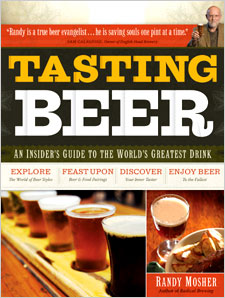
Tasting Beer was an enjoyable read The beginning follows the same pattern any beer book does it follows the history of beer in 20 or so pages going from the ancient Sumerians & ancient Egyptians to the modern brewing industry, stopping to talk about porters in England along the way. Still Tasting Beer is more than just a general beer book.
The second chapter starts the tasting portion sensory evaluation, judging tips, presentation of beer, pairing beer with food. This is the portion of the book thats most useful. Tasting beer can be a difficult subject to broach in print but The book gives you a method to efficiently communicate whats going on in your glass and mouth. The book discusses some of the common flavors found in beers (intentional and off flavors) mouthfeel, carbonation, and how the brewing ingredients and process effect the final product. The book has several charts showing the differences in color, alcohol, and bitterness relative to styles.
The last half of the book is a discussion of styles. They are separated by country of origin and go briefly into the history of the given styles. This part was a bit tedious at times (reading about 15 styles and their original gravities/ IBU's can be boring at times) as it reads somewhat like a list.
Randy Mosher is part of the faculty at the sibel institute, he teaches courses in sensory panel management among otheres. He is a well respected author and lecturer in the beer world.
Overall i really enjoyed the book. I feel it started me on the road to really tasting and evaluating beer rather than just drinking it, however, reading a book is no substitute for experience when it comes to tasting and judging beer but thats the fun part. This book comes highly recommended
September 15, 2011
Beer School
I have been planning on going to beer school after i graduate SUNY Albany. Originally I was looking at the American Brewers Guild but recently i changed my mind and decided to go to the Siebel Institute. Here are the strengths and weaknesses from both institutions as far as I see them.
American Brewers Guild:

ABG was my first choice, they only offer online or "distance learning" classes which I was planning on taking anyway, they have locations in Windsor Vermont and Sacramento California where the final exam will be held. They offer two types of courses, First the intensive brewing science and engineering (IBS&E) which is a 23 week course including a week long residential study at a working brewery. Tuition is $6,750 which includes all books and materials. Second, the craft brewers apprenticeship (CBA) is a 28 week course it also includes a week long residential study but goes further in offering a 5 week (unpaid) internship at a working craft brewery. Tuition for this program is $8,950 including books and materials.
For both programs the prerequisites are as follows
Math: Precalculus or algebra
at least one from the following list
(1) Biology: microbiology, cell physiology or biochemistry
(2) Chemistry: general college level chemistry (must include organic, inorganic and analytical)
(3) Physics: heat and mechanics or process control
(4) Engineering: topics in mechanical or chemical engineering
I expected the prerequisites but the major issue with ABG is that they have such small class sizes that registration is closed until 2014 (not a typo) and even then there are lots of people waiting to get in meaning I would have to really put my education on hold. That being said I really like the internship opportunity with a craft brewery.
The Siebel Institute:

Recently I changed my plan, originally I was going to wait and got to ABG but now i have decided to go to Siebel. Siebel is the oldest brewing school in the US (founded 1868). The degree you get from Siebel seems, to me at least, to be more respectable.
Siebel is located in Chicago but also offers distance learning programs. Siebel offers many types of courses from an advanced homebrewing course to the full on master brewers program. They have an international reputation as well working with the Doemens academy in Germany, the Institute for brewing and distilling (IBD) in the UK and the World brewing academy (WBA).
The cost of different programs and individual classes varies from $810 for a business of brewing overview to $20,000 for the entire master brewers program. I chose to start on the associates in brewing technology. It consists of 3 "modules" (like semesters) raw materials and wort production, beer production and quality control, and packaging process and technology (will run a little over $9,000 total). These are all considered upper level courses and instead of listed prerequisites you can either take the concise course in brewing technology (2 week introductory course, no prerequisites) or contact Keith Lemcke (vice president at Siebel and WBA). In an effort to skip the intro course I contacted Keith and he basically gave me an interview via email. He asked about my brewing experience, educational background, titles of specific books I have read and my goals for brewing education. After my assessment he told me it was basically up to me but that most people entering the course are already professional brewers or have more sciences than I do but ultimately it was up to me.
I decided to take the concise course first then enter the upper level course because i don't want to be behind before i start even though this will add another $3,000 to my total cost.
Why did I choose Siebel if they don't offer an internship and i will spend more money ? I actually want to enter the brewing industry sometime before I'm 40 and i can work on my studies at Siebel on a module by module basis while still at SUNY and hopefully graduate from college and beer school at about the same time.Also the range of courses offered at Siebel is way more in depth and the faculty includes some famous figures in the beer world (Ray Daniels, Randy Mosher, Chris White).
Additionally I think while I'm studying at Sibel I may be more recognized when I'm shopping my resume around.
Subscribe to:
Posts (Atom)